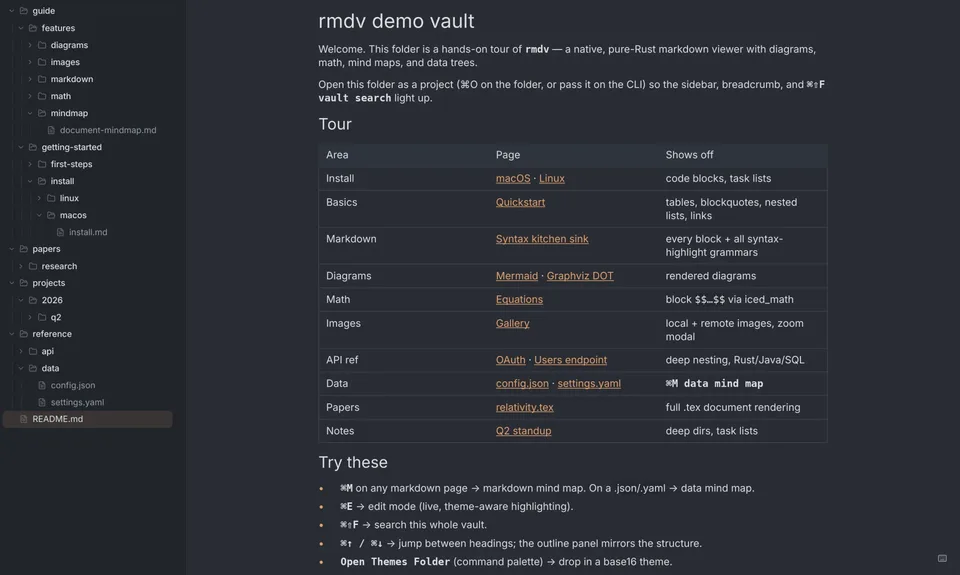
Read the whole Markdown workspace.
rmdv opens a folder as a fast, native reading surface: file tree, rendered documents, mindmaps, diagrams, search, and a command line that can keep the right section in view.
No Electron · no webview · no JavaScript runtime in the app · 100% made with AI

A folder becomes a workspace.
Open existing files where they already live. There is no import step, vault format, or hidden copy.
- Browse
- A familiar file tree and fuzzy finder for moving between documents.
- ⌘P
- Map
- Document mindmaps for structure; Full Mindmap for workspace navigation.
- ⌘⇧M
- Search
- Search one document or the whole folder without leaving the reader.
- ⌘⇧F
- Edit
- Make a focused change in place, with unsaved work protected across navigation.
- ⌘E
The document stays the visual focus.
Markdown, code, diagrams, math, JSON, YAML, TOML, and text PDFs are rendered locally with the same restrained interface around them.
Built around the keys you already use.
The table uses the reader's native app bindings and names. Try j and k on this page, or press ⌘/ for website shortcuts.
On Windows and Linux, rmdv uses Ctrl instead of ⌘. The seven app shortcuts above are shown for reference and are not captured by this website.
The reader has a command line.
Shell scripts, editor extensions, and coding agents can keep the running window on the file and heading a person needs. Each command returns one line of JSON.
# open a spec at the relevant line
rmdv path/to/spec.md --line 42

# move the existing window
rmdv goto --section "API/Authentication"
rmdv mode mindmap
rmdv current

# inspect a file without opening a window
rmdv list-sections spec.md | jq -r '.[].path'
One native instance. Commands talk to the running app over a local socket.
Useful state, not prose. Machine-readable responses make the interface dependable in scripts.
Human stays oriented. An agent can reveal its source material at the exact section being discussed.
Small enough to feel immediate.
The renderer is viewport-aware: only visible blocks become widgets. These historical measurements are evidence, not current guarantees.
v0.2.0 on an Apple M2 MacBook Pro, median of five runs; current builds may differ. Read the methodology.
Before you install.
The important boundaries, stated plainly.
- Is rmdv free and open source?
- Yes. rmdv is MIT-licensed and free to use, modify, and distribute. The source is public on GitHub.
- What is the difference between document Mindmap and Full Mindmap?
- Document Mindmap turns the current Markdown, JSON, YAML, or TOML file into a tree. Full Mindmap is a separate workspace navigator for folders and files, with a read-only preview.
- How is rmdv different from Obsidian?
- rmdv is a read-focused viewer, not a note-linking knowledge base. It opens folders without vault setup and has no plugin ecosystem.
- How is rmdv different from Typora?
- Typora is a paid editor-first app. rmdv is free, open source, read-focused, and runs on macOS, Linux, and Windows.
- Does rmdv work offline?
- Yes. Rendering, diagrams, math, mindmaps, and supported PDF text extraction happen locally with no cloud dependency.
- What diagram and math formats are supported?
- Mermaid, Graphviz DOT, and block LaTeX are rendered natively, without JavaScript or KaTeX.
- How does rmdv work with coding agents?
- The
rmdvCLI can open files, jump to headings, change view modes, and return current state as JSON over local IPC. - How do I install it?
- Use the macOS disk image, the Linux AppImage, or build from source with Rust 1.80 or newer. After opening a packaged app, use Install CLI from the command palette to expose the rmdv command. Windows builds disable the PDF feature.
- Is it faster than Electron-based viewers?
- rmdv has no Electron, webview, or JavaScript runtime. Historical v0.2.0 measurements found about 150 ms to first view; current builds may differ.
Open the folder. Start reading.
Free, open source, and available as a native desktop app.